
Why AI Adoption Stalls Without Time to Learn, Test, and Verify
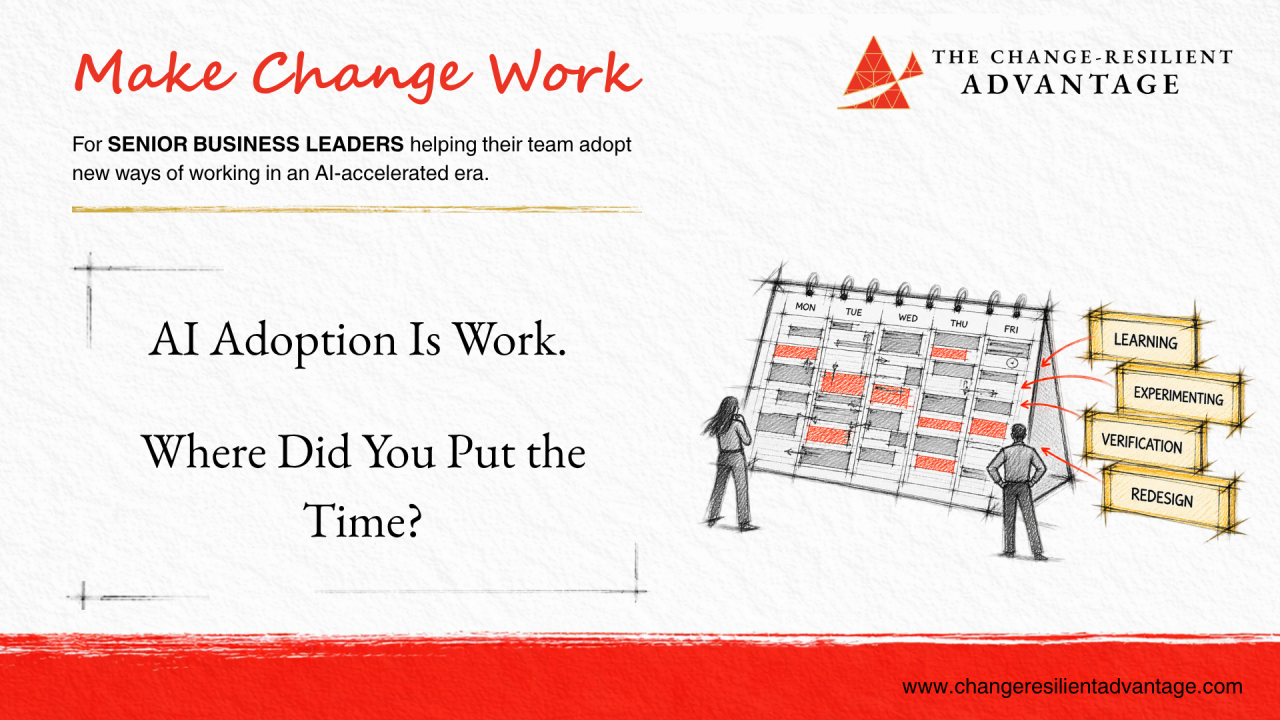
AI adoption asks people to learn, experiment, verify, and redesign the work. If the calendar stays full, where does that work go? | Images co-created with AI
AI adoption often stalls because organizations treat it as a technology rollout rather than a change in how work gets done. People need protected time and attention to learn what a tool can do, experiment with real applications, verify output, and redesign workflows. When that work is added to full calendars, learning disappears under delivery pressure, pilots sit on top of day jobs, and experienced employees may decide that checking AI output takes longer than completing the task themselves.
This can look like resistance. More often, people are making rational choices about deadlines and accountabilities that have not changed. AI can also move work instead of eliminating it. Faster drafting may generate more material to review, more options to evaluate, and new quality-control or approval demands elsewhere in the workflow.
Leaders therefore need to examine the whole system: where time is saved, where new work appears, who carries it, and what existing work will be reduced, delayed, or stopped. Encouragement creates permission, but credible adoption requires room in the workload. Protecting time for learning, experimentation, verification, and redesign turns AI adoption from an additional demand into a leadership choice that the organization can actually support.
The work has to go somewhere
In the last issue, we explored how trust in AI gets decided through everyday experience. One question underneath that trust was simple: Do people have time to check the output?
Many organizations ask people to adopt AI while leaving their workload untouched. Leaders provide tools and encourage experimentation, but expect employees to fit the work around everything else they already deliver. When every hour is spoken for, adoption becomes an extra demand that people absorb on their own.
Time is only one dimension of a person's capacity to navigate change. It is also a concrete condition leaders control. Without enough time and attention, people have less room to learn, exercise judgment, manage uncertainty, and adapt their work.
In our conversations with senior leaders about AI adoption, roughly two-thirds raised the cost of checking AI-generated work. More than a third spoke directly about the time required to learn, test, and integrate the tools, usually without being prompted. Learning was often the first activity to disappear under pressure, pilots sat on top of day jobs, and experienced employees sometimes found that verification took longer than completing the task themselves.
Encouragement may create permission to begin but it does not create the time and attention required to continue.
Four kinds of work sit inside adoption
“Use AI” sounds like a single action. In practice, adoption contains at least four kinds of work:
Learning: Understanding what a tool can do, where its limits are, and how to apply it responsibly.
Experimenting: Testing real applications, comparing approaches, and learning from weak results.
Verification: Checking whether output is accurate, complete, appropriate, and safe to use.
Redesign: Reconsidering handoffs, decision rights, quality controls, and the division of work between people and technology.
Each consumes time and attention. When leaders treat this work as invisible, the demand remains and the cost shifts to employees.
The calendar reveals the real strategy
Leaders may call AI adoption a priority. Employees look at what has been protected: time, attention, support, and permission to slow down while they learn.
Without those conditions, people make rational choices. They return to familiar methods when deadlines tighten, limit experimentation to low-risk tasks, or stop after an unreliable result because they lack time to diagnose the cause. Pulling back from AI experimentation can look like resistance. People may be directing scarce time and attention toward work for which they remain accountable.

What looks like resistance may be a rational response to competing demands on people's time and attention.
Available time also shapes trust. If employees are expected to use AI and remain responsible for every result, they need time to exercise that responsibility. Otherwise, verification becomes a burden and appropriate caution can be mistaken for reluctance.
AI can move the constraint
AI may accelerate drafting, analysis, or routine tasks. Time saved at one point does not automatically create room elsewhere in the organization.
A recent executive roundtable showed how easily the constraint can move. Faster production may create more material for someone else to review. More options can increase the judgment required to choose among them. Additional output can add coordination, quality-control, or approval work downstream.
Leaders need to examine the whole workflow: where time is saved, where new work appears, who carries it, and whether the overall process improves. A tool can make one task faster while making the surrounding system more demanding.
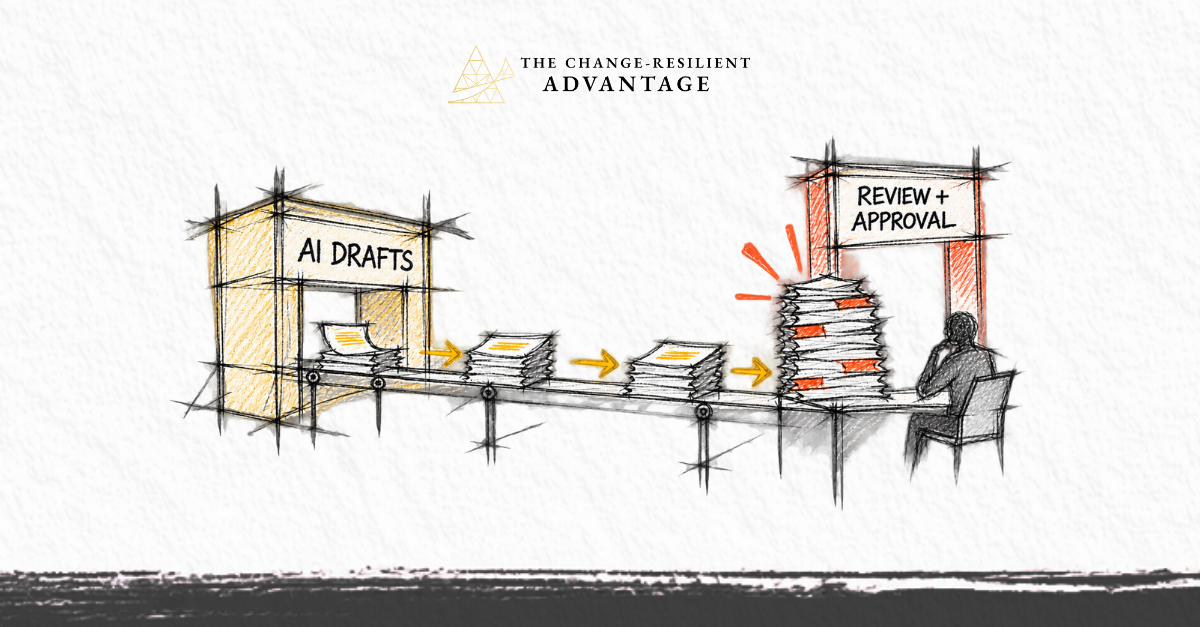
AI can speed up one task while moving the constraint to review, judgment, or approval downstream.
Creating room for adoption is a leadership choice
Creating room for adoption does not require an open-ended innovation program. Leaders can narrow the number of use cases, reduce another demand for a defined period, schedule structured experimentation, or assign clear responsibility for verification and workflow redesign. During a pilot, expectations can also reflect that learning is part of the work.
Start with five questions:
What must people learn to use this tool well?
Where will experimentation happen, and how much time will it receive?
Who will verify the output, and what will that require?
Which parts of the workflow may need to change?
What existing work will be reduced, delayed, or stopped?
The final question turns encouragement into a credible adoption strategy. AI adoption requires leaders to recognize learning, experimentation, verification, and redesign as real work, then create the conditions for that work to happen.
Bring one real AI priority to our next Leader Exchange
The time and attention required for adoption are among the questions leaders need to work through before committing more resources to an AI priority.
At our next Leader Exchange, From AI Adoption to Business Value, we will introduce a practical test for examining the path from AI adoption to business value. Bring one real priority from your organization. You will identify where your thinking is already clear, where important questions or assumptions remain, and what conversations or work may need to happen next. You will also learn from how peers are approaching similar decisions.
Join us Tuesday, October 13, from 12 to 1 p.m. ET.
Apply to request your seat. Space is limited.
About The Change-Resilient Advantage
The Change-Resilient Advantage makes critical change work in practice. We partner with senior leaders and organizations to create the leadership and culture conditions people need to adopt new ways of working, especially as AI and advanced technology accelerate the pace and pressure of change.
Across our engagements, measurable results have included 100% of leaders reporting increased confidence to lead their teams through restructuring, 95% of employees gaining clarity on a new organizational vision, and sustained improvements in engagement, collaboration, and ownership through periods of significant change. Learn more at www.changeresilientadvantage.com.
