
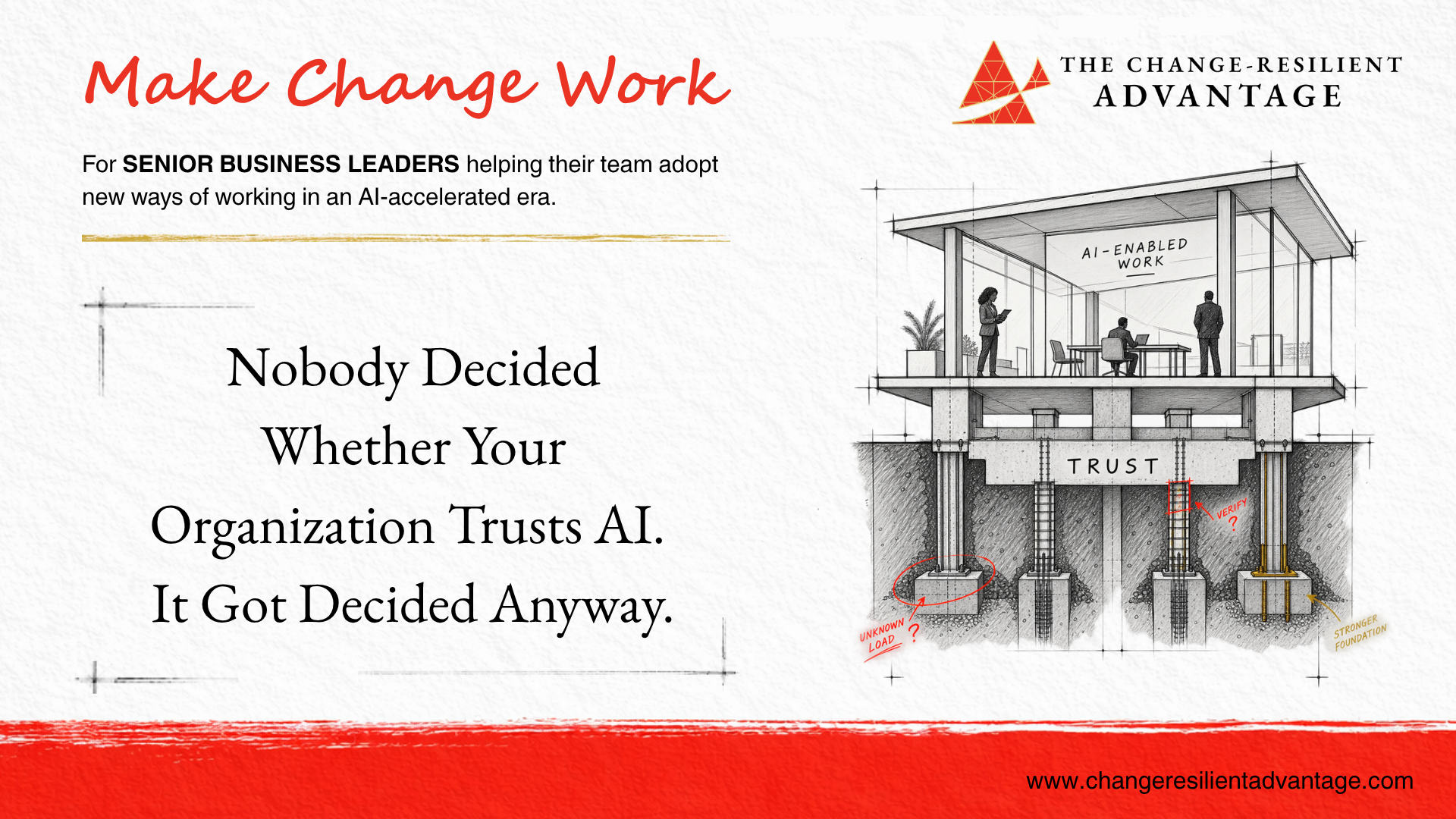
Trust isn't the ceiling on AI adoption. It's the foundation, and most organizations haven't checked whether theirs will hold.
Ask a senior leader whether their organization trusts AI, and the honest answer is usually "it depends." Trust didn't come up as a direct answer to a direct question in conversations with senior leaders across banking, healthcare, manufacturing, nonprofits, and other sectors. It surfaced sideways: in a story about a hallucinated number, a comment about typos in an email, an aside about a report that never should have gone out. Put those pieces together and four separate questions emerge. Two are about the output: is it correct, and do people have time to check it? Two are about the people using it: does the work have to look human, and do you trust your people to use it well? None of this is settled yet, which is exactly why it keeps getting decided without anyone deciding it. Leave any of the four unanswered, and the organization answers it anyway, just by default instead of on purpose. This issue walks through what senior leaders told us about each question, then explains why answering all four matters more than answering any one well.
Trust Splits Into Four Separate Questions
Ask a leader directly whether their organization trusts AI and the honest answer is usually "it depends," followed by an example that only covers part of the picture. That's what genuinely working through something new looks like. In conversations with senior leaders, trust rarely came up as a direct answer to a direct question. It surfaced sideways: in a story about a hallucinated number, a comment about typos in an email, an aside about a report that never should have gone out. Put those pieces together and a pattern holds. Trust splits into four separate questions:
Is the output correct? One leader asked a model for a board white paper. It told them it had invented the data: "oh, I just made this up." Another leader described a model that confidently confirmed the wrong information about a client meeting, and held its ground when challenged. They only caught it because they'd had the same conversation with a person. Their takeaway: "once you hit it once, you're very cautious, because you're responsible for making sure that everything's correct."
Do people have time to check it? "I'm throttling back. I don't have enough time to test the amount of information that the AI provides," one leader said, explaining why they scaled back their use of the tool. Another named the shared reality plainly: "it's a lot of work to verify the AI, and we all agree it is."
Does the work have to look human? One leader deliberately puts typos into messages so people know a human wrote them. Another asked a colleague whether they could tell a report was AI assisted, was told "not one bit," and took that as proof of quality. Once work looks like AI, several leaders told us, it gets discounted before anyone weighs what it actually says.
Do you trust people to use it well? One organization caught an AI-drafted annual report before it reached the board. The organization's own human-written reports typically prompt board members to say something like "I felt like you were sitting right here next to me." The AI draft had none of that. Elsewhere, a loan officer described applicants submitting AI-drafted business plans they clearly hadn't read themselves, baffled that someone asking for money hadn't reviewed their own pitch. The more a tool proves itself, the more verification tends to erode. One leader described analysts who stopped checking AI-generated output altogether once the tool had earned their trust, work that included information a decade out of date went out unreviewed. Confidence built from early wins can crowd out judgment as thoroughly as no confidence ever could.

The four questions, side by side. Which one can your organization answer with confidence?
Why all four matter
None of this is settled yet, and that's exactly why it keeps getting decided without anyone deciding it. Leave one of these questions unanswered and it still gets answered, just not by you. Solve output accuracy but skip verification time, and careful people quietly stop using the tool rather than keep checking it. Skip the question of whether work has to look human, and it gets decided too: work gets discounted the moment it looks like AI, before anyone weighs what it says, and making sure it doesn't look like AI becomes a hidden tax on every piece of work. Skip the fourth question and the gap shows up outside your own walls, in a board packet, on a lender's desk, wherever trust was placed in AI output that hadn't earned it, whether that trust came from the organization or from the person using the tool.
These four questions are a diagnostic for whether the human conditions around a new way of working got built on purpose or left to develop on their own. An unanswered question doesn't stay unanswered, it gets settled by whatever happens by default. Training people to use AI is not the same as building the trust that makes the tool worth relying on. That takes the same work as any other change: naming what's actually true, giving it real time, and building the answer with the people using the tool every day. A better model doesn't answer any of these four questions. Leading the change around it does.
The reminder behind this issue: build trust on purpose, don't wait for the technology to earn it alone.
Run your own organization through the four this week. Whichever one you can't answer with confidence is where to start. If you'd rather get a real answer than a guess, a short diagnostic conversation can tell you exactly where you stand and what to do about it. Reach out to set one up.
About The Change-Resilient Advantage
The Change-Resilient Advantage partners with senior leaders and organizations navigating high-stakes change and AI adoption. We build the leadership and culture conditions that get your people to adopt new ways of working.
Clients have seen measurable results including 100% of leaders reporting increased confidence to lead their teams through restructuring, 95% of employees gaining clarity on a new organizational vision, and sustained market share growth during industry decline. Learn more at www.changeresilientadvantage.com
