
Why Uneven AI Adoption Needs Diagnosis Before Intervention
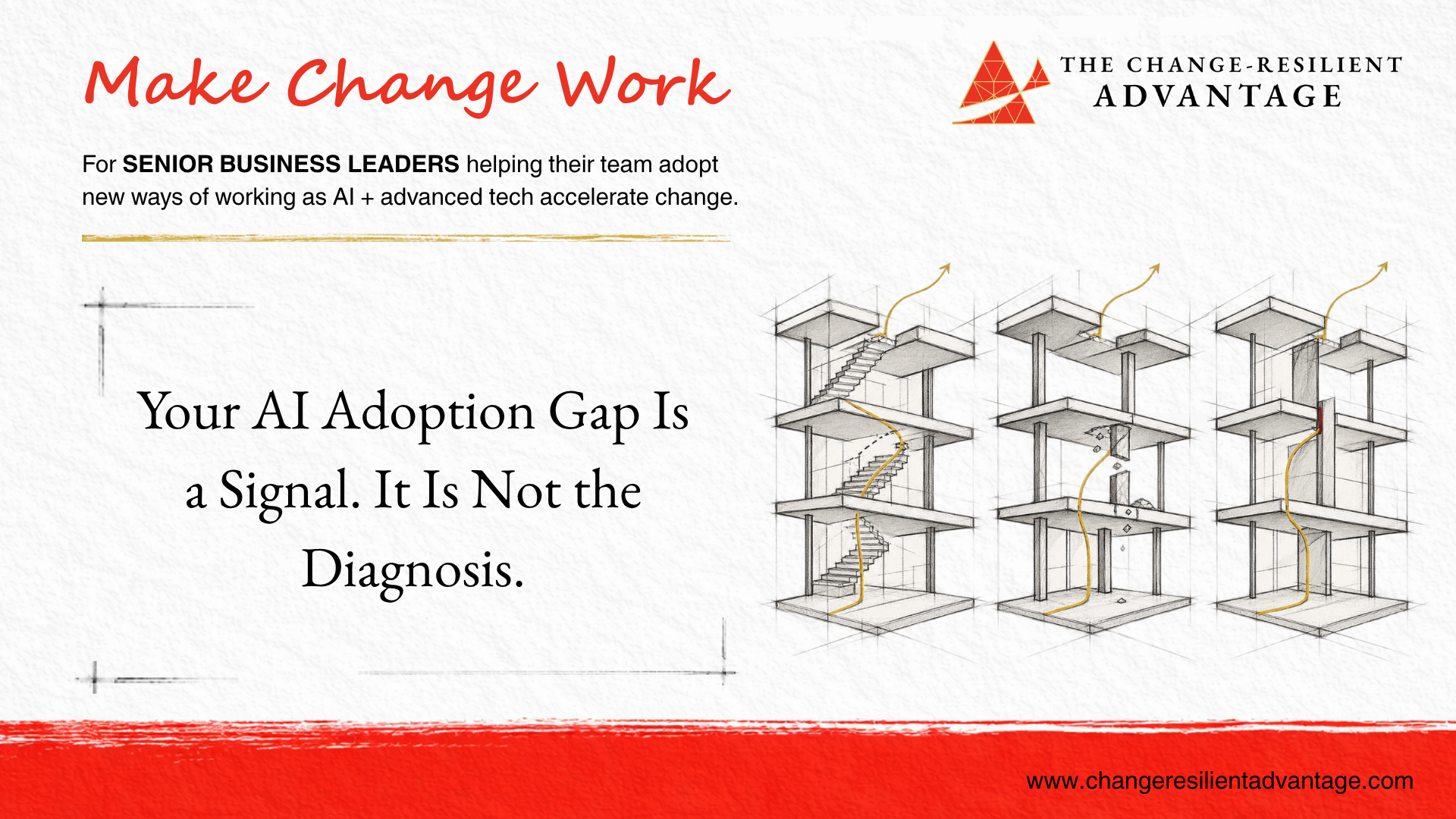
The same adoption gap can point to very different change problems. | Images co-created with AI
Uneven AI adoption does not point to one problem. The same visible gap can reflect differences in capability, relevance, available time, manager behavior, permission, culture or how the change is being implemented.
Before deciding how to increase adoption, leaders need to establish where AI is expected to change how work gets done and what needs to be true for people to adopt that new way of working. Usage, adoption and capability are different signals, and each can require a different response.
The goal is not uniform AI use for its own sake. It is to understand whether the intended change is taking hold, where it is not, and why. That diagnosis helps organizations distinguish a genuine skill gap from a capacity, leadership or implementation problem and choose an intervention that addresses the actual barrier.
You can see the gap. You can't see the cause.
Uneven AI adoption comes up a lot in conversations with leaders. Some people are experimenting extensively. Others use AI for a handful of tasks. Some barely engage at all.
We've heard very different explanations for those differences. Age comes up. So does role type, how comfortable someone's manager is with AI, whether the person has a practical need for it in their work, and whether the culture makes experimentation easier or harder.
From a change perspective, the interesting part is what happens next. Once leaders see a gap, they have to explain it. If the explanation is that the people lagging behind lack skill, motivation or willingness, the response tends to follow: train them, encourage them, set expectations or push harder.
That may be exactly what is needed. But the behavior alone doesn't tell you that.
The same gap can point to different change problems
Consider two teams that have both been asked to experiment with AI. One manager makes room for it, discusses what the team is learning and gives people permission to try. The other supports AI in principle, but learning happens whenever people can squeeze it around their actual jobs.
We've heard that distinction repeatedly. Leaders describe time rather than willingness as the constraint. Some organizations encourage people to use AI without creating time to learn it. Others deliberately carve out space for experimentation and sharing. Telling the second team to become more motivated won't put an hour back into anyone's calendar.
Sometimes capability really is the issue. We've also heard examples of people distrusting AI output when at least part of the problem was that they didn't yet know how to use the tool effectively. Poor prompting produced poor output, and the tool was blamed for the result. Greater skill might materially change that experience.
This is also why usage, adoption and capability shouldn't be treated as interchangeable. Usage tells you whether someone is using AI. Adoption tells you whether AI has become part of how they do the work in a way that improves it. Capability tells you how effectively they can use it.
If you don't know which of those you are looking at, it is very easy to prescribe the wrong response. Training applied to a capacity problem gives an already overloaded team one more thing to do. Pressure where the value of the change is unclear can generate AI activity without improving the work. And better conditions won't solve a genuine skill gap.
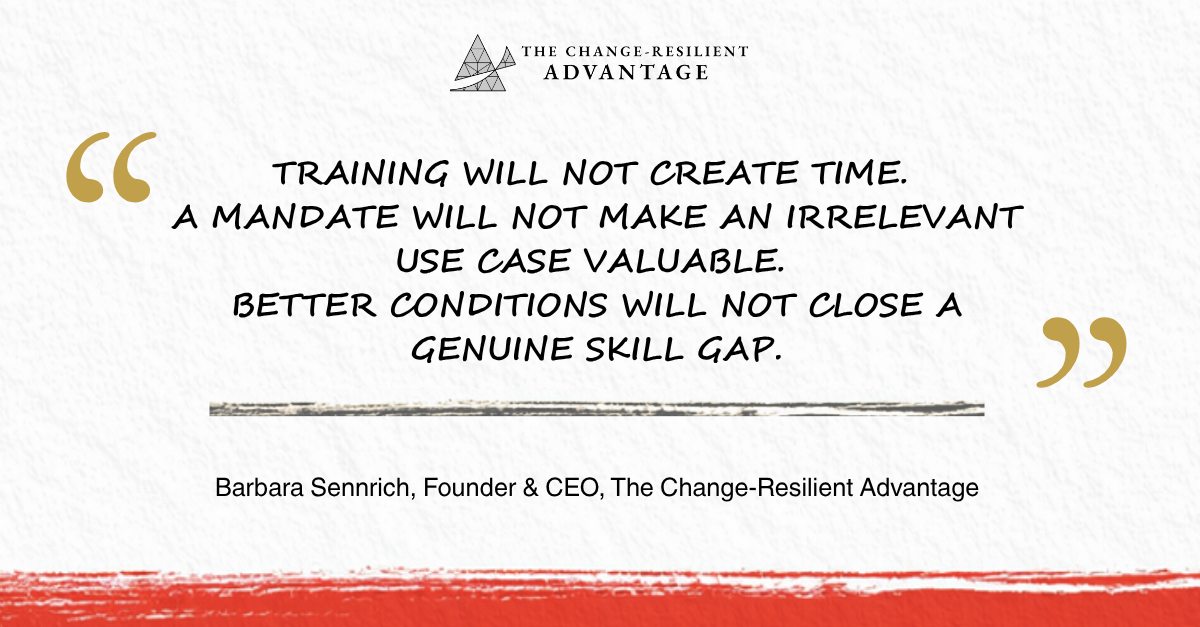
The adoption gap is a signal. It is not the diagnosis.
The goal is a better way of working, not a more even chart
Different work creates different opportunities for AI. Even people with similar titles may be working with different processes, data, risk or customer requirements. So How do we get everyone using AI more? can be the wrong place to start. It assumes the behavior should increase before establishing what should actually be different about the work.
A more useful sequence is:
Where is AI expected to change how work gets done?
What needs to be true for people to adopt that new way of working?
Now the adoption gap gives you somewhere to investigate.
Is the intended change clear and relevant?
Do people have the capability to work differently?
Do they have the time and permission to learn?
Are managers reinforcing the change?
Are legitimate implementation problems being surfaced?

What you can see is the gap. The right questions help uncover what sits underneath it.
You may arrive at different answers in different parts of the organization. That may be exactly the information you need.
There is also a reason to understand those differences before making judgments about who is and isn't keeping up with AI. If employees have had materially different opportunities to learn, experiment and apply it, some of the capability difference you eventually observe may have been shaped by those conditions. Individual responsibility still matters. So does understanding what you are actually measuring.
Business value depends on what happens after the decision
Leadership has an important role in deciding where the organization is going with AI and where it believes AI can create value. But value only materializes when the work actually changes.
The people doing that work therefore need to be part of the picture. They see the friction, workarounds, judgment calls and constraints that determine whether a new way of working will succeed in practice. Bringing that information upward doesn't mean every strategic decision gets reopened. It gives leadership better information about what it will take to implement those decisions successfully
That is why uneven adoption calls for investigation before judgment. It can show you where the intended change is taking hold, where it isn't, and where you need to look more closely before deciding what to do about it.
On October 13, we'll take that question further at our next Leader Exchange: Finding where AI creates business value (and why it can't be done from the top).
We'll bring senior leaders together to pressure-test whether one real AI priority has a credible path to business value, what the people closest to the work can see that leadership may not, and what needs to come back to leadership for a decision.
If you're working through that question in your own organization, join us for the conversation.
Apply here to participate in the October 13 Leader Exchange
About The Change-Resilient Advantage
The Change-Resilient Advantage makes critical change work in practice. We partner with senior leaders and organizations to create the leadership and culture conditions people need to adopt new ways of working, especially as AI and advanced technology accelerate the pace and pressure of change.
Clients have seen measurable results including 100% of leaders reporting increased confidence to lead their teams through restructuring, 95% of employees gaining clarity on a new organizational vision, and sustained improvements in engagement, collaboration, and ownership through periods of significant change.
Learn more at www.changeresilientadvantage.com.
