

We build the conditions that make high-stakes change and AI Adoption take hold
We partner with leaders navigating high-stakes change and AI adoption. Our work is the human side: the leadership alignment, culture conditions, and governance that determine whether new ways of working actually take hold, and whether they last.
When leaders engage us
Leaders engage us when new ways of working need to take hold and last beyond the announcement.
We are most often brought in during:
AI adoption and technology-enabled redesign
Organizational restructuring and redesign
Leadership transitions and operating model shifts
Strategic resets where alignment and execution are critical
Post-merger integration or separation complexity
Return-to-office and work model changes

Misdiagnosis Is Expensive
Execution breakdowns are often treated as communication or engagement issues alone. When the real constraint is depleted capacity, delays compound and recovery becomes more difficult and costly.
Common costs include:
Slower adoption and extended timelines
Rework that compounds instead of resolving issues
Increased turnover and loss of critical talent
Manager burnout and erosion of leadership credibility
Recovery efforts that exceed original scope
When capacity is misread, pressure increases in the wrong places, and execution deteriorates faster.
Where we step in during critical change
Organizations engage us in different ways depending on urgency, clarity, and execution risk.
Some start small and focused. Others engage across multiple phases.
Most engagements fall into one of three patterns.

focused
Advisory
Senior-level partnership for high-stakes decisions.
This engagement strengthens leadership judgment and alignment before execution begins.
Typical focus:
Clarifying priorities and trade-offs
Exploring implications of major choices
Identifying early execution strain
Aligning senior leaders on non-negotiables
Typical format:
Delivered through a defined series of working sessions with direct access to senior advisors, rapid synthesis, and practical guidance tailored to live decisions.
Primary outcome:
Clearer direction and stronger alignment before momentum is lost.

Targeted Change Support
Targeted support to stabilize execution at critical moments.
This engagement restores clarity, ownership, and consistency when execution begins to strain and friction starts to multiply.
Typical focus:
Leadership alignment around active change
Communication systems tied directly to real work
Manager enablement grounded in execution
Ownership and adoption design
Typical format:
Defined scope and timeframe, combining facilitation, structured working sessions, and hands-on support across leadership and management levels.
Primary outcome:
Stabilized execution, reduced rework, and renewed momentum.

Multi-phase partnership
Sustained partnership for high-risk transitions.
This engagement carries complex organizational change across multiple phases without loss of alignment, capacity, or credibility.
Typical focus:
End-to-end execution design
Ongoing leadership alignment
Integrated communication cadence
Manager and team enablement
Capacity strengthening under pressure
Typical format:
A multi-month partnership with regular leadership touchpoints, structured milestones, and iterative adjustment as conditions evolve.
Primary outcome:
Sustained execution discipline and durable adoption through ongoing change.
Capacity is built through execution
Across all engagement types, we help leaders strengthen capacity as part of the execution work itself.
This improves:
Decision quality under pressure
Stability in leadership behavior
Follow-through across levels
Consistency of execution
This is not generic development work. It is practical support grounded in real decisions, real constraints, and real consequences.

How engagements are structured
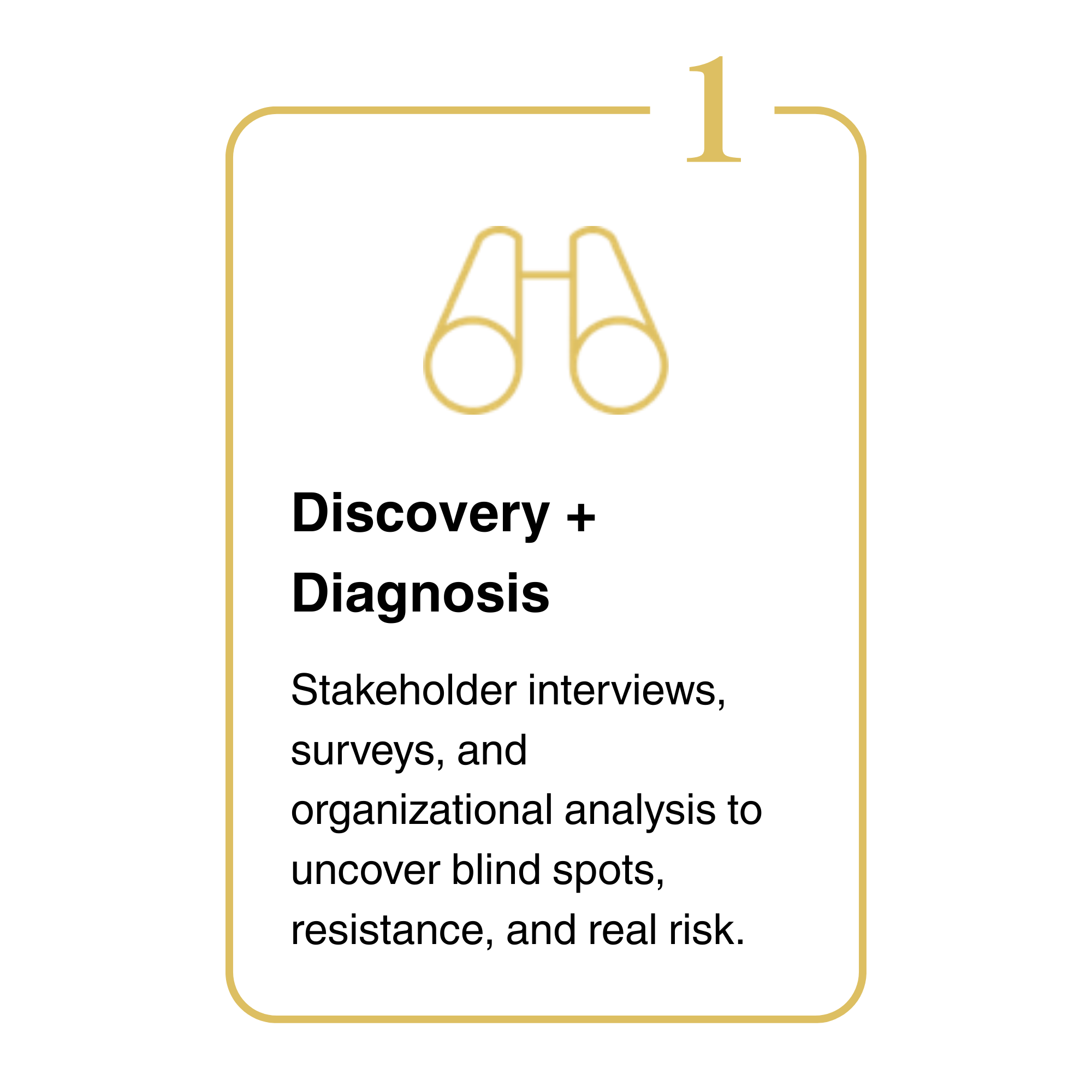
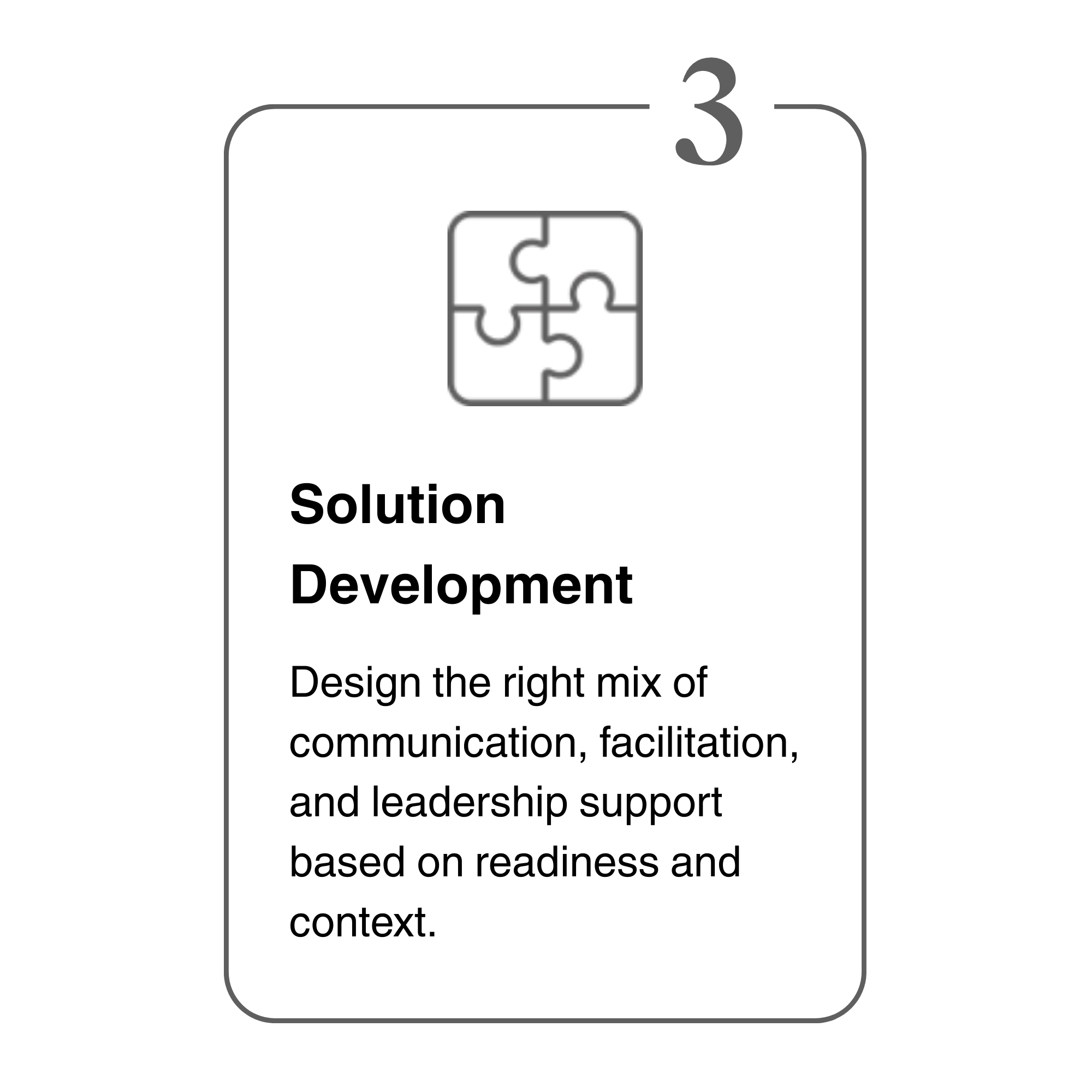
While engagements vary in scope, we use a consistent arc to ensure decisions don’t get lost between intent and execution.



How engagements typically begin
There is no single entry point. We tailor our starting point based on clarity, complexity, and urgency.
Engagements often begin with:
An exploratory conversation
A pressure test of existing plans
A clarity or alignment session
A short discovery phase
Early work is designed to create shared understanding and inform next steps, not force a larger commitment.


Ready to explore
working together?
If you're navigating high-stakes change or AI adoption and want senior support grounded in real experience, let's talk.