
3 Signs Your AI Adoption Picture Doesn't Match Reality
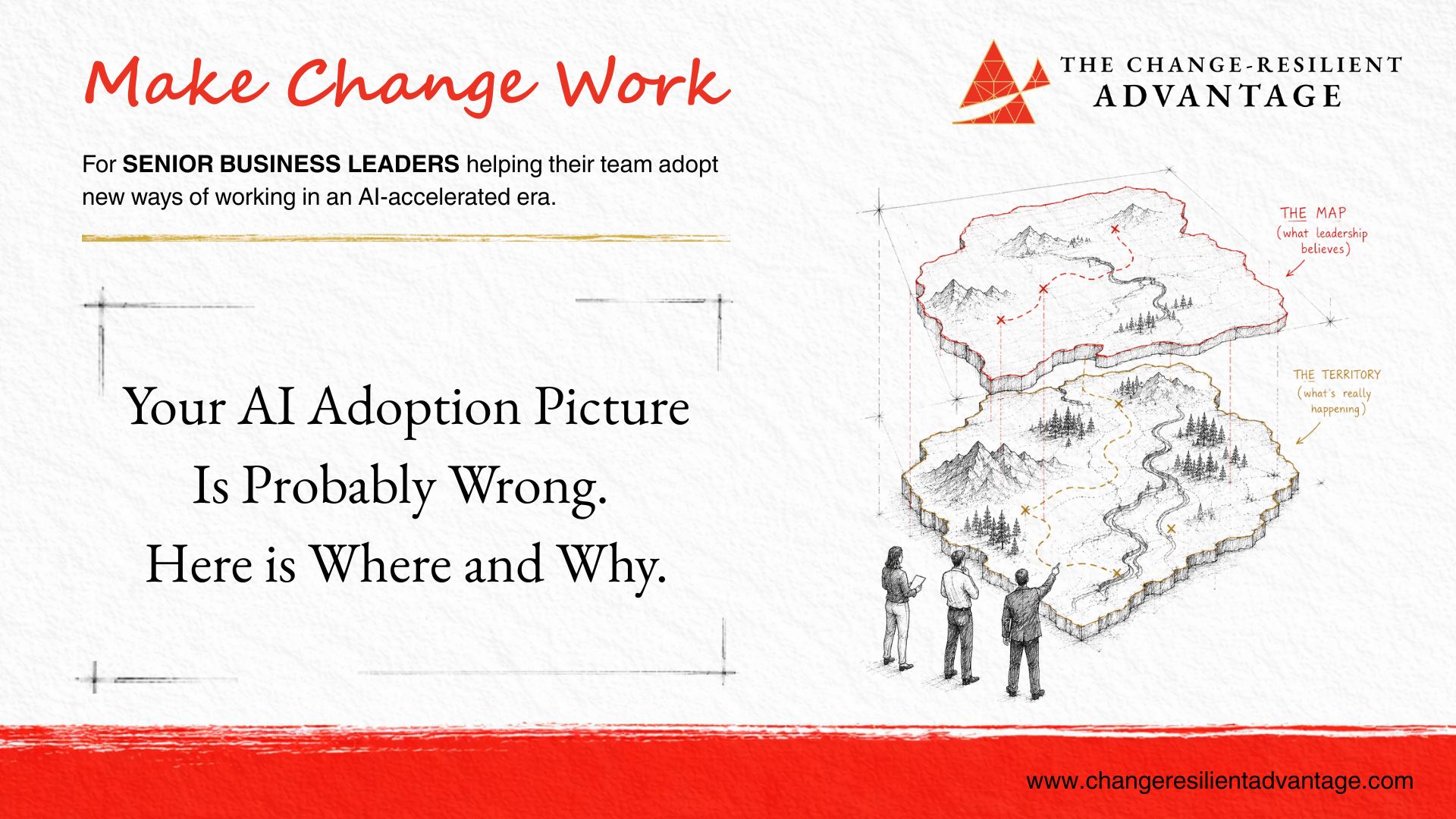
The map is what leadership believes. The territory is what's actually happening. This issue is about the gap between them.
Most leadership teams believe they have an accurate picture of how AI adoption is going inside their organization. That picture is often wrong, in specific, recurring places, and leaders rarely find out until someone asks the right question. Three real examples: a vision that never made it past the leadership table, AI proficiency being quietly hoarded as personal job security, and a year of employee silence a VP mistook for reassurance. None of this shows up on a dashboard or in an engagement survey. The biggest risk is leadership making decisions on training, strategy, and where to invest, based on a picture of AI adoption that doesn't reflect reality.
Where the Map Splits From the Territory
What follows are three moments from recent conversations with senior leaders, each in a different function, a different sector, a different kind of gap. We're sharing them because each one exposes the same kind of blind spot, even though the specific shape is different every time.
1. The Vision That Never Left the Boardroom
This is the gap we hear about most, and it shows up more than one way.
Sometimes the vision stays with the CEO. Sometimes the whole leadership team has it, and it still doesn't reach past that table. And sometimes what leadership has communicated is itself a moving target, shifting as the technology shifts week to week, so "speaking with one voice" stays a goal rather than a current reality.
We hear versions of this across sectors, healthcare, education, insurance, nonprofits, and across sizes, from five-person teams to global enterprises. The details change but the gap doesn't.
Leaders routinely mistake having said something for having communicated it. An announcement is not alignment. A good line in a strategy deck is not a shared understanding two levels down.
The cost: leadership keeps wondering why execution lags a strategy nobody has actually heard, and reaches for explanations, capability, motivation, will, that have nothing to do with the real problem. That's true whether the vision stalled with the CEO, the whole leadership team, or never stopped shifting long enough to land. Either way, people within the organization have never heard it.
2. The Expertise People Are Keeping to Themselves
If a strong AI user on your team hasn't taught anyone else what they know, it's tempting to chalk it up to busyness, ego, or a personality quirk.
Twice now, in two different marketing organizations, we've heard something else: people who've gotten genuinely good at AI, making a quiet, deliberate choice not to teach anyone else. Ask why, and the answer follows a simple logic. In a job market where people are wondering whether they'll be replaced, AI proficiency has become personal insurance. Teaching it away means handing over the one thing that might protect you.
That's a rational response to a real signal, and it won't respond to more training. Training assumes people want to close the gap between what they know and what their colleagues know. Here, the gap is the point.
The cost: the training budget gets spent solving a knowledge problem that was never the real constraint, while the insecurity underneath it goes untouched and the hoarding continues exactly as before.
3. The Question Nobody Asked
One conversation with a VP of Operations stands out for how clearly it shows the mechanism at work. He meets with his direct reports every week. Between direct and indirect reports, that's more than a hundred people. Across a full year, AI had never once come up. His first read on that was reassurance: if it mattered, someone would have raised it.
Then, thinking it through out loud, he landed somewhere else. He had never actually asked. Not once, across dozens of conversations, had he raised it himself. He'd been reading an absence of signal as an absence of activity, and it took saying it out loud to notice those aren't the same thing. It's an easy assumption to make. Most attentive, well-intentioned leaders make some version of it every week, about something.
The cost: any decision resting on "this isn't coming up, so it must not be urgent or matter" is resting on nothing. Silence was never evidence. It just felt like it.
What Connects These Three
Different functions, different situations, different specific gaps. But the shape underneath repeats: leadership had a picture, reality had already moved somewhere else, and nothing in the normal course of running the business caught the difference. The vision gap doesn't surface until someone outside the leadership circle actually asks. The silence only became clear when someone kept talking past their first, comfortable answer. The hoarding is being managed on purpose, by people making a reasonable bet that leadership will never ask.
That gap has a real cost: every decision made on top of it. The training budget aimed at the wrong problem. The confidence that a message landed when for some people it never left the room. The plan built on a hundred conversations that never actually happened.
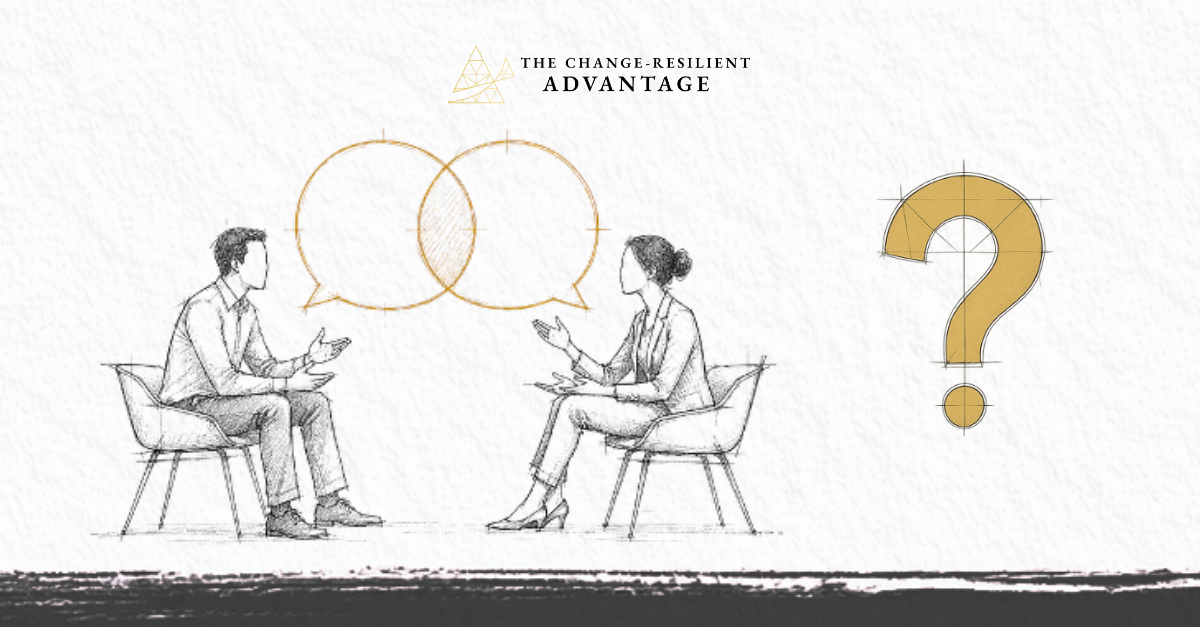
The overlap only happens when someone actually asks the question. Most leaders assume it's already there.
None of it shows up on a dashboard or in a survey. Most organizations spend their attention, and their budget, on the layer where dashboards and platforms live, and these three gaps live somewhere else entirely. That's where we're headed next: why so much investment lands on the one layer that can't see any of this, and where the real leverage actually sits.
What else are you currently assuming is fine, simply because no one's told you otherwise?
You won't find that out by yourself. Every leader in these three examples only saw the gap because someone else asked, or because they said it out loud to someone who was actually listening.
On July 29th, we're bringing senior leaders together for our next Leader Exchange to go through what our AI Insights conversations with senior leaders are actually revealing, and where your own picture might already be out of date. Apply to participate here.
Want a more direct read on your own organization instead? A diagnostic conversation does the same thing, one-on-one. Click here to schedule a call.
About The Change-Resilient Advantage
The Change-Resilient Advantage partners with senior leaders and organizations navigating high-stakes change and AI adoption. We build the leadership and culture conditions that get your people to adopt new ways of working.
Clients have seen measurable results including 100% of leaders reporting increased confidence to lead their teams through restructuring, 95% of employees gaining clarity on a new organizational vision, and sustained market share growth during industry decline. Learn more at www.changeresilientadvantage.com
