
The Leadership Confidence Gap: Why AI Adoption Stalls Before It Starts
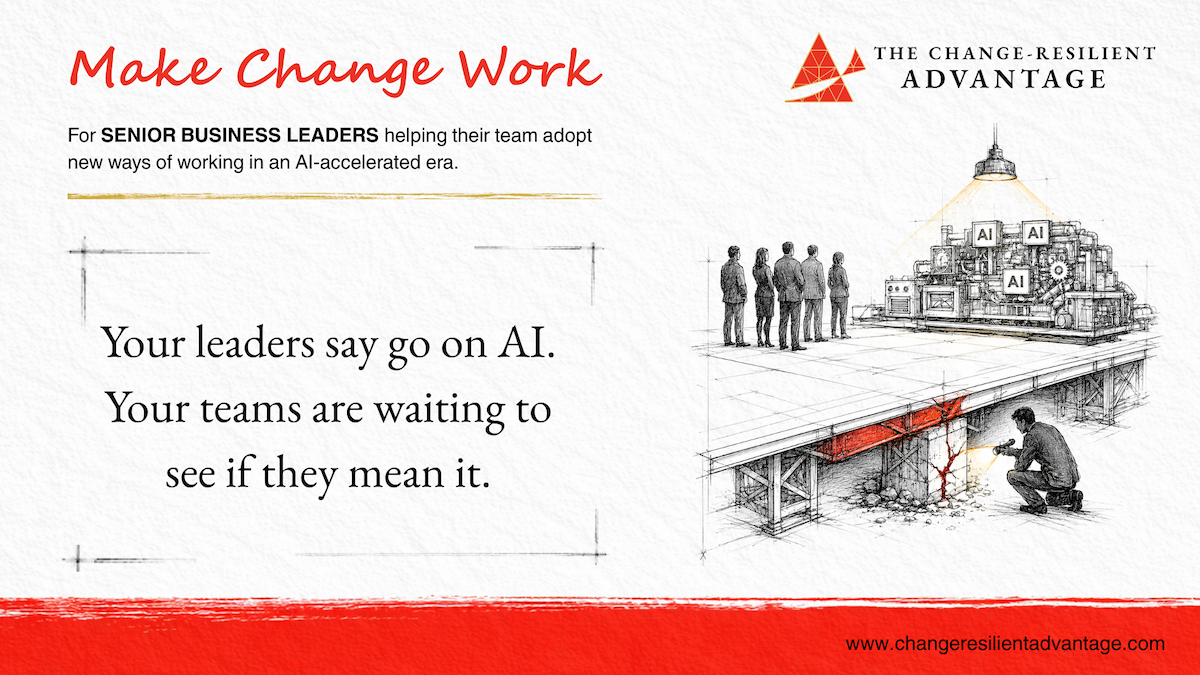
MIT's 2025 State of AI in Business report puts a number on what many senior leaders are already sensing: U.S. businesses have invested between $35 and $40 billion in generative AI, and 95% are seeing no measurable return. MIT calls it a learning gap. In conversations with senior leaders across industries, we are seeing where that gap starts. It starts with the leader. AI triggers a specific threat response rooted in identity. The leadership model that built their authority, deep expertise, certainty, knowing the answer, is the same model AI is asking them to move away from. Until leaders make that identity shift, from leading by knowing to leading by learning, that gap will not close.
What we are hearing from senior leaders
A senior leader we spoke with recently gave voice to something we’ve been noticing more broadly: there are leaders in their organization who don’t feel confident enough in how they are using AI to be encouraging their own teams.
That observation was describing a gap between where leaders are privately and what they are able to model publicly. And they said it with the quiet recognition of someone who had been watching it play out in real time.
Where a leader is personally experimenting with AI, comfortable not having all the answers, willing to figure it out alongside their team, adoption follows. Where a leader is uncertain and that uncertainty stays private, teams go quiet. They read the silence and they wait.
The pattern points to the same place every time. Adoption moves when leaders move first.
Why confidence is the variable that matters
MIT's researchers found that the 95% who see no return on AI pilots are failing because of a learning gap, the inability to translate AI into real, usable processes inside the organization. That gap has a human source. Organizations cannot close a learning gap when their leaders are not modeling learning themselves.
Installation and availability of new tools don’t lead to adoption. People need to feel safe enough to experiment, curious enough to try, and supported enough to fail without consequence to actually use them. Those are culture conditions a leader creates, and they are shaped more by what a leader does than by what a leader says.
When a leader is quietly anxious about AI but publicly endorsing it, the team receives a mixed signal. The words say go but the behavior says wait and see. They comply without adopting. They attend the training without changing how they work. They wait for someone to show them it is safe to move.
The confidence gap has a nervous system explanation
Twenty years of navigating organizational change has shown one constant: change adoption has always been a human challenge. Because change introduces uncertainty and uncertainty triggers a threat response in our brain and nervous system.
AI amplifies the threat response with particular force for leaders, because it challenges the identity their authority is built on: deep expertise, certainty before acting, knowing the answer.
The new environment asks for something close to the opposite. Speed over certainty. Learning in public. Experimenting alongside the team rather than directing from established knowledge. That is not just a behavior change. It is an identity shift. And until that shift happens, the behavioral pattern is predictable: avoidance, delegation without personal engagement, verbal endorsement that never translates into visible modeling.
Training addresses capability. This is an identity question. It requires a different kind of intervention.
What this means for your organization
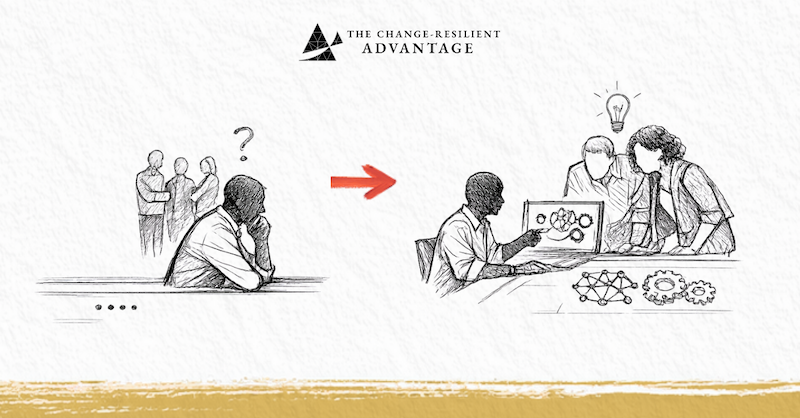
The leaders who are making AI adoption work have moved through the identity shift, have moved from leading by knowing to leading by learning. That means being willing to not have the answer, to experiment in front of their teams, to say out loud that they are figuring it out alongside everyone else.
Those leaders are your adoption engine. Their teams are moving.
The leaders who are not there yet represent the highest-return opportunity in your adoption strategy. Supporting their identity shift is where the leverage is. Building the conditions for leaders to learn visibly, experiment safely, and model curiosity openly is the work that moves the whole organization.
What we have described here happens at the individual level. Whether that pattern resolves, or keeps reproducing itself across leaders and teams, is determined by something running underneath the whole organization. Next issue, we go there.
Join the conversation on July 29th
We are currently conducting a series of insights conversations with senior leaders across industries about what is actually happening inside organizations as they navigate AI adoption. On July 29th we will be sharing the broader themes emerging from that research at our next Leader Exchange, a peer conversation for senior leaders navigating exactly these questions.
If you would like to be part of that conversation, you can express interest here: https://www.changeresilientadvantage.com/articles#apply
About The Change-Resilient Advantage
The Change-Resilient Advantage partners with senior leaders and organizations navigating high-stakes change and AI adoption. We build the leadership and culture conditions that get your people to adopt new ways of working.
Clients have seen measurable results including 100% of leaders reporting increased confidence to lead their teams through restructuring, 95% of employees gaining clarity on a new organizational vision, and sustained market share growth during industry decline. Learn more at www.changeresilientadvantage.com.
