
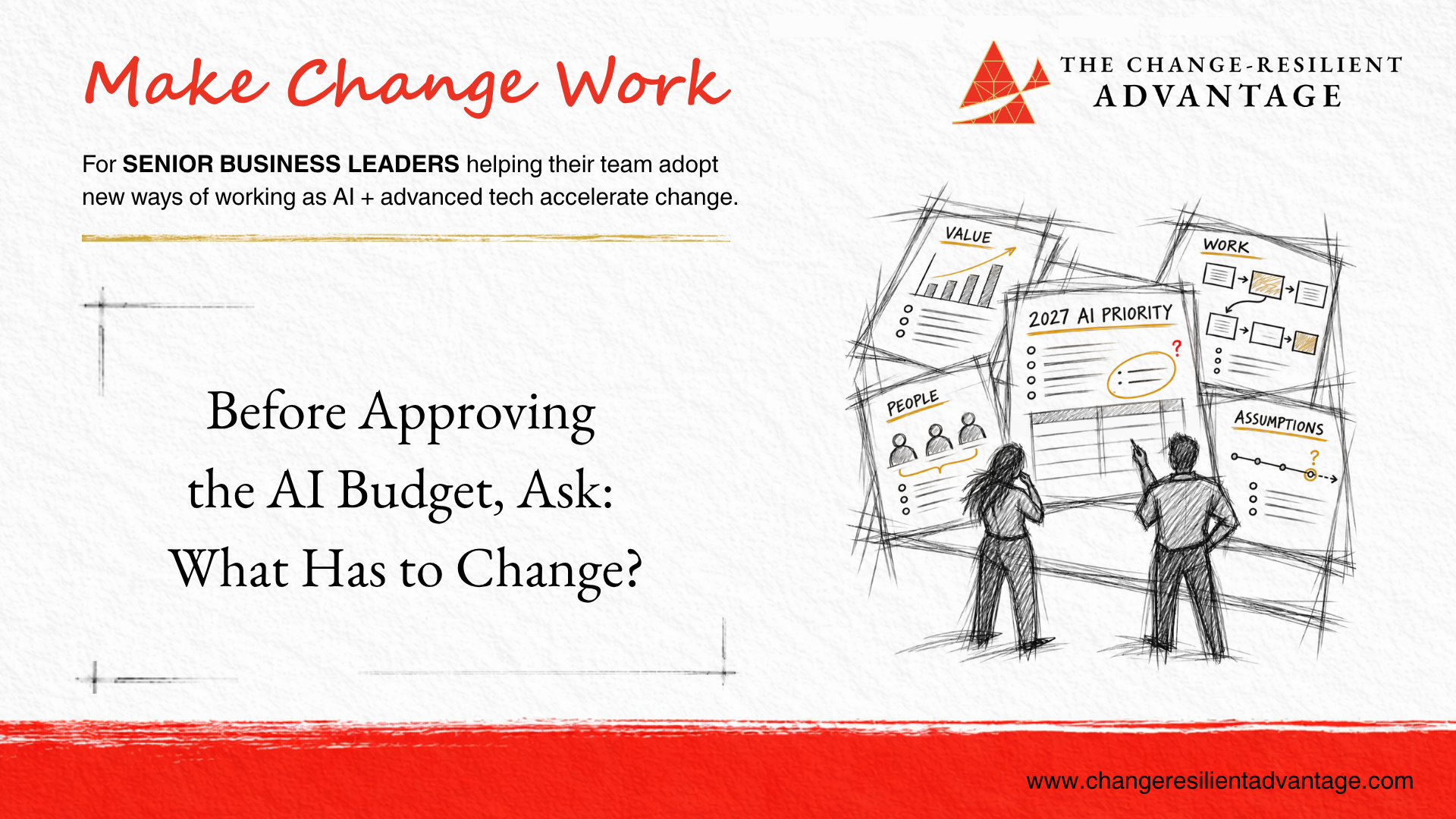
Before committing the AI budget, examine what the investment will require in practice. | Images co-created with AI
Viewed through the lens of organizational change, an AI budget needs to account for how work must change and what people need to adopt and sustain it. A proposal may specify technology, training and expected savings while leaving these requirements unresolved.
Four connected questions help leaders examine an AI priority: What business value is intended? What needs to change in everyday work? What conditions will help people adopt and sustain those changes? And what assumptions underpin the path and timing of the expected results?
Faster task completion needs to connect to a meaningful outcome. Existing processes may need reconsidering, with input from the people closest to the work. Personal capacity, clarity, trust, ownership and reinforcement need attention, alongside time for learning and adjustment. Dependencies, responsibilities and evidence need owners.
Examining these questions before committing funding helps leaders identify what should be clarified or tested and account for implementation requirements in the investment decision.
What the AI Budget Needs to Account For
As organizations set priorities and budgets for 2027, AI is one of several investments competing for money, time, and leadership attention.
Where AI is a priority, the investment conversation needs to examine the changes in work and behavior required to create business value.
An AI proposal can look convincing on paper: a use case, technology, training, and estimated time savings. Its business result depends on people changing how they work. The proposal needs to account for that transition.
Work may need to be redesigned. People need to learn, adapt, and apply judgment differently. Managers need to support the transition. And if the business case depends on saved time, leadership needs to decide what that time will become.
These requirements belong in the investment conversation.
We approach AI investment through the lens of organizational change. Our Adoption-to-Value Test uses four connected questions to examine how work must change and the conditions people need to adopt and sustain it, so the intended business value can be realized.
1. What business value are we trying to create?
Imagine an organization proposes using AI to help employees prepare reports faster.
What does faster preparation make possible?
Perhaps the goal is to reduce costs, respond to customers more quickly, or give employees more time to analyze information and make better decisions.
Each outcome requires different changes in work and priorities.
If the goal is better analysis, has that work been identified? Have priorities changed to make room for it? How will the organization assess whether decisions improve?
The proposal needs to explain how people will use the time saved. Changed priorities and working practices connect faster report production to the intended business benefit.
The question to resolve: What should be meaningfully better, and how would the organization recognize it?
2. What needs to change in how work gets done?
Before adding AI to an existing process, leaders need to examine whether that process still makes sense.
Return to the reporting example. Are all those reports still needed? Are they providing the information people need? Could that information be gathered, analyzed, and shared differently?
If the goal is better decisions, faster drafting may address only a small part of the opportunity.
AI gives organizations a reason to reconsider the work: remove unnecessary steps, change how information flows, and rethink responsibilities and decisions around what is now possible.
Change in one task affects the work around it. Faster drafting could increase reviewers’ workload while leaving an approval bottleneck untouched.
The people closest to the work can help identify what should be retained, reconsidered, or redesigned. Their experience grounds those choices in how the process actually operates.
The question to resolve: How does the work need to change to create the intended value?
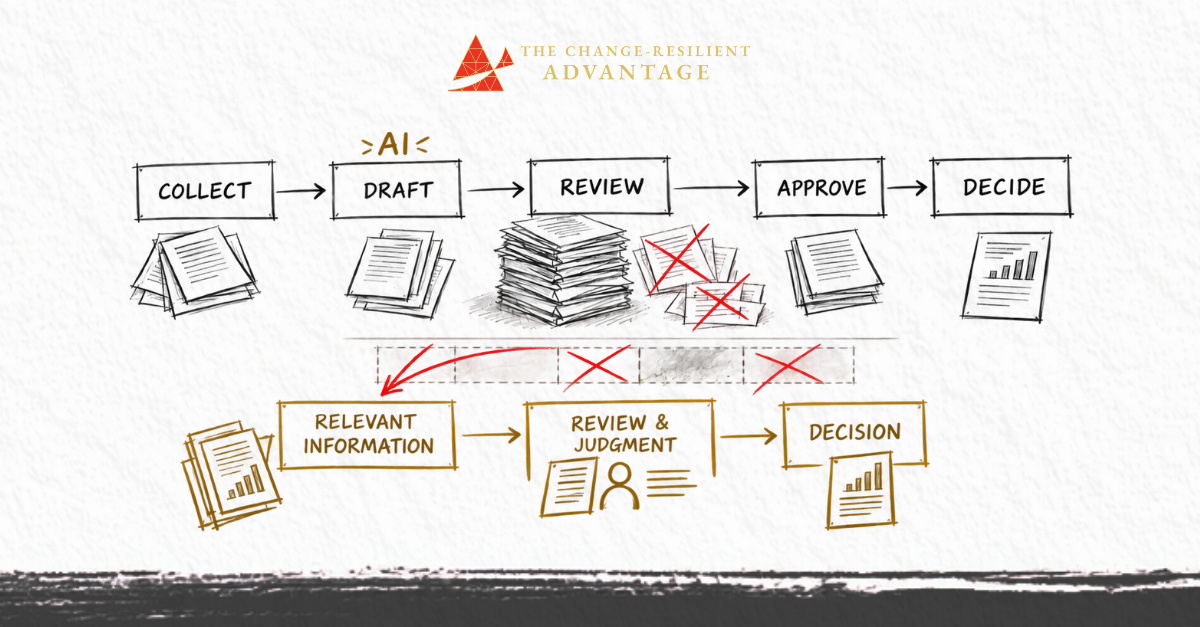
Adding AI to an existing process creates an opportunity to reconsider the work itself.
3. What must be in place for people to adopt and sustain those changes?
Access and training are useful milestones. People still have to make the new approach part of everyday work.
At The Change-Resilient Advantage, we focus on five conditions that support that transition:
Capacity: Personal steadiness, perspective, and agency to navigate uncertainty and engage with change.
Clarity: Understanding what is changing, why it matters, and what it means in practice.
Trust: Being able to raise concerns, question outputs, and acknowledge uncertainty.
Ownership: Meaningful influence over how the new approach will operate.
Reinforcement: Leadership and organizational practices that support continued action and learning.
Building these conditions takes attention. People also need practical provision for learning, experimentation, and adjustment, including time within their working day.
Who will prepare managers, involve affected teams, resolve concerns, and review how the new arrangements are working?
If those responsibilities remain implicit, the investment depends on change nobody has been assigned to support.
The question to resolve: Has the plan accounted for what people need to work differently?
The human implementation requirements belong in the investment decision.
4. What are we assuming about how and when value will materialize?
A business case might anticipate benefits within six months. What changes must take hold first?
People need usable tools and data, time to learn, agreed responsibilities, and support to establish new working practices. The pace of that transition affects when value becomes realistic. Those requirements need owners.
The evidence also needs to match the claim.
In the reporting example, faster drafting would demonstrate a task improvement. Leaders would still need evidence that changed working practices produce the intended result, such as faster customer responses or better decisions.
Leaders don’t need every answer before moving forward. They do need to know which assumptions carry the greatest weight and what could be tested before making a larger commitment.
The question to resolve: What must happen first, what would demonstrate progress, and when should results reasonably be expected?
A useful starting point is to examine one AI priority under consideration for 2027. Where an answer is uncertain, the next step is to identify the conversation, decision, or experiment needed.
Budget season provides an opportunity to account for the work of change before committing funds.
Comment VALUE below and we’ll send you a one-page Adoption-to-Value Test to help you examine one real AI priority before committing the budget.
About The Change-Resilient Advantage
The Change-Resilient Advantage makes critical change work in practice. We partner with senior leaders and organizations to create the leadership and culture conditions people need to adopt new ways of working, especially as AI and advanced technology accelerate the pace and pressure of change.
Clients have seen measurable results, including 100% of leaders reporting increased confidence to lead their teams through restructuring, 95% of employees gaining clarity on a new organizational vision, and sustained improvements in engagement, collaboration, and ownership through periods of significant change.
